

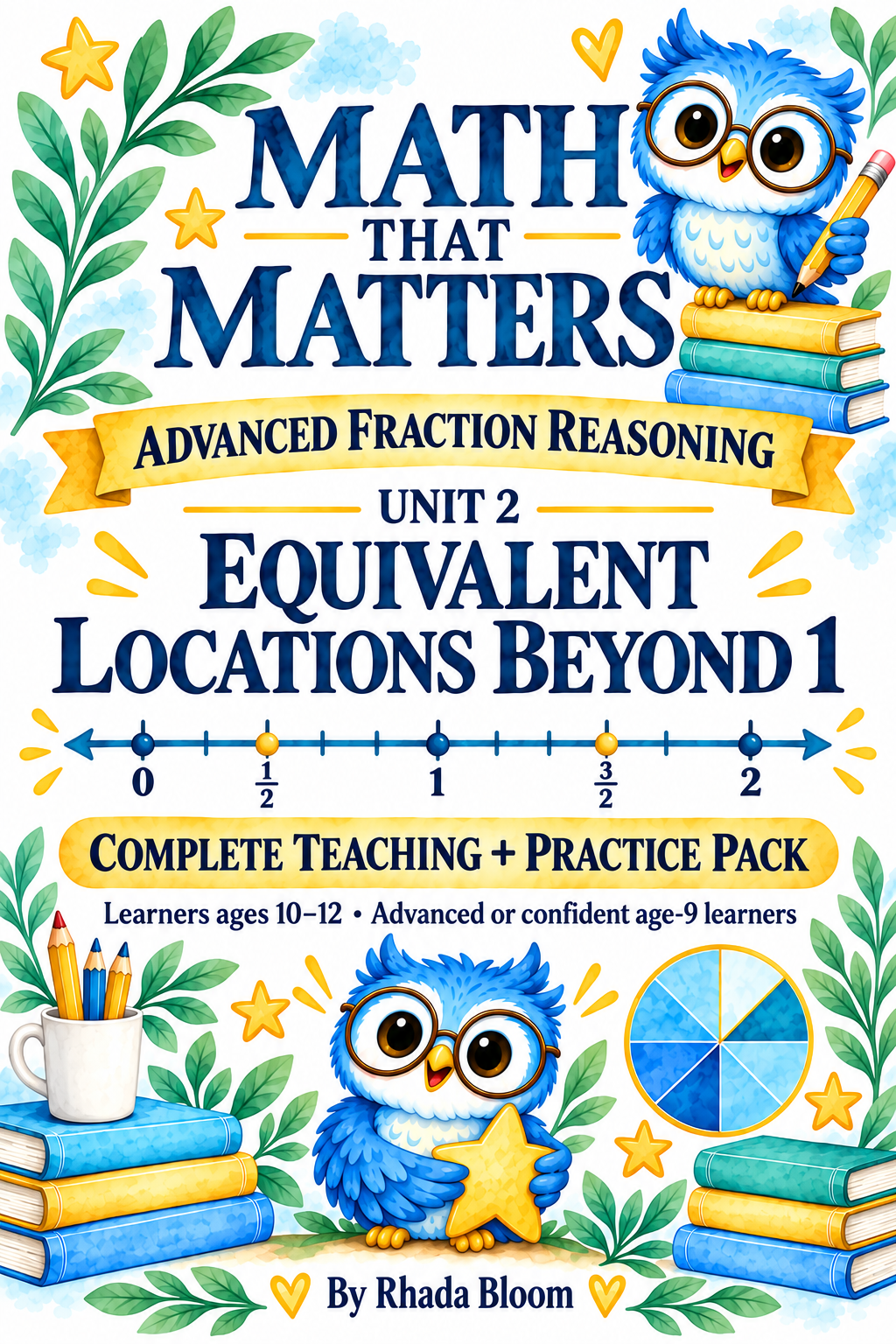
MATH THAT MATTERS ADVANCED FRACTION REASONING UNIT 2 EQUIVALENT LOCATIONS BEYOND 1 : Learners ages 10–12 and Advanced or confident age-9 learners
Equivalent Locations Beyond 1
Complete Teaching + Practice Pack
Math That Matters — Advanced Fraction Reasoning • Unit 2
Fractions become much harder when learners are taught to manipulate symbols before they understand where a fraction actually belongs, what the denominator controls, and why different fraction names can represent the same value.
Equivalent Locations Beyond 1 is a meaning-first fraction reasoning unit designed to help learners see fractions as locations on a number line, not simply numbers written above and below a fraction bar.
Learners work with equal intervals, unit-fraction jumps, equivalent names, improper fractions, mixed numbers, benchmarks, and locations beyond 1. They are repeatedly asked to show why an answer works, not only produce a final fraction.
The unit is designed primarily for ages 10–12, with ages 9+ appropriate when the learner already has secure fraction foundations.
DIGITAL DOWNLOAD — 3 PDF FILES
84 total PDF pages
START HERE — Parent & Educator Guide — 11 pages
Teaching guidance, pacing, materials, Parent Preview, misconceptions, and Quick Adult Check.
Learner Workbook — Teaching + Practice — 53 pages
Meaning-first teaching, visual examples, guided reasoning, practice, error analysis, real-life decisions, explanation, and Mastery Check.
Answer Key & Support Tools — 20 pages
Reasoning-based answers, printable fraction strips, Equivalent Location Planner, Reasonableness Checklist, and Sentence Frame Bank.
Best for Ages 10–12 • Ages 9+ with Secure Fraction Foundations
What You Receive
This purchase includes three coordinated PDF resources.
1. START HERE — Parent & Educator Guide
This is the adult guide to the unit.
It explains what the learner is expected to understand, how the learning sequence works, which materials may be useful, how to pace the unit, and which misconceptions to watch for. The guide directs the adult to begin with the Parent Preview, then move the learner into Teach It First, while the separate Answer Key & Support Tools file is used as needed.
The learning system moves through:
Parent Preview → Teach It First → See It → Build It → Connect It → Practice It → Error Detective → Decide in Real Life → Explain Your Thinking → Mastery Check
Each stage has a different job: first understanding the goal, then seeing and building the mathematics, connecting models to symbols, practising, diagnosing errors, applying the idea, explaining reasoning, and finally deciding what should be reviewed next.
The Parent & Educator Guide also includes:
- Suggested pacing and session structure
- Core materials
- Intervention and enrichment options
- Common misconceptions
- A Parent Preview
- A quick adult check
- Guidance for responding to incorrect answers without simply giving the rule
The standard unit is designed to be used across approximately 3–5 sessions, although individual sections can also be used for shorter focused practice.
2. Learner Workbook — Teaching + Practice
This is the main learner-facing resource.
It begins with TEACH IT FIRST, so the learner is introduced to the mathematical meaning before being asked to complete independent practice.
The central idea is that a fraction on a number line describes a location. The denominator determines the size of the unit-fraction jump, while the numerator tells how many jumps to make from 0. Learners continue the same reasoning beyond 1 rather than treating fractions as numbers that must stay between 0 and 1.
The workbook develops understanding through several connected forms of reasoning.
Learners practise how to:
- Identify one whole before placing a fraction
- Count equal intervals rather than tick marks
- Use the denominator to determine the unit-fraction jump size
- Use the numerator to determine how many jumps to make
- Locate fractions at and beyond 1
- Rename improper fractions as mixed numbers without changing their location
- Recognize that equivalent fractions can use different-sized unit fractions but still name the same point
- Compare fractions using benchmarks such as 1
- Distinguish a fraction's mathematical value from the physical length of a drawing
The teaching pages also address misconceptions directly. For example, learners examine why counting tick marks instead of intervals changes the denominator, why fractions can extend beyond 1, why the denominator does not change after crossing a whole number, and why centimeter length on a printed page does not determine fraction value.
More Than Routine Practice
The learner is not asked to repeat one procedure over and over.
Different sections ask the learner to interact with the mathematics in different ways.
- BUILD IT uses objects, strips, grids, movement, and equal spacing to make the denominator visible.
- CONNECT IT links the model to number lines, fraction names, and equations.
- PRACTICE IT provides a short set of problems where learners must solve and show how they know.
- ERROR DETECTIVE asks learners to find where reasoning first goes wrong, explain why it changes the value or location, and repair the work.
- DECIDE IN REAL LIFE moves the mathematics into a decision context. Learners work with fraction locations and distances, including deciding which labels describe the same station and whether locations satisfy conditions before or after 1 km.
- EXPLAIN YOUR THINKING asks for the reasoning behind the answer rather than only the answer itself.
Finally, the MASTERY CHECK is completed without looking back. Its purpose is not simply to produce a score; the result tells the learner what to do next:
4–5 secure: move on and explain one problem aloud.
2–3 developing: review Connect It and retry a related Error Detective problem.
0–1 not yet: return to Build It with new numbers and then try the check again.
3. Answer Key & Support Tools
This is more than a list of final answers.
The answer key is built around reasoning. For open-response work, adults are encouraged to check the whole or unit, the model, the equation, and the conclusion rather than requiring identical wording.
It includes answers for:
Teach It First Quick Check
See It
Build It
Connect It
Practice It
Error Detective
Real-Life Decision
Explanation tasks
Mastery Check
The file also contains additional support materials.
Printable Fraction Strips include wholes and partitions into 2, 3, 4, 5, 6, 8, 10, and 12 equal parts.
Equivalent Location Planner gives learners a repeatable process:
Find one whole → Count equal intervals → Name one jump → Count from 0 → Name the location → Rename the same point → Check the scale.
The pack also includes a Reasonableness Checklist so learners can check whether the whole, denominator, numerator, mixed-number name, equivalent name, and physical drawing all make mathematical sense.
A Sentence Frame Bank supports mathematical explanations for locating fractions, equivalence, fractions beyond 1, mixed numbers, comparisons, scale, error analysis, and decision-making. Learners are not required to copy the frames exactly; models, equations, number lines, and clear mathematical language are also accepted.
What Learners Are Working Toward
By the end of the unit, the learner works toward being able to:
- Divide a number line using equal intervals rather than counting tick marks
- Place equivalent fractions from 0 to 3
- Work with improper fractions and mixed numbers
- Use position and distance from a benchmark to reason about fraction locations
- Recognize when a number-line drawing has accidentally changed the size of one whole
The emphasis throughout is:
Find the whole. Understand the interval. Locate the value. Explain why it works.
Who This Resource Is For
This pack is a strong fit for:
- Learners ages 10–12 who are ready to reason about fractions beyond basic shaded shapes.
- Advanced or confident age-9 learners who already have secure fraction foundations.
- Learners who can perform some fraction procedures but still struggle to explain why they work.
- Learners who confuse tick marks with intervals on number lines.
- Learners who assume every fraction must be between 0 and 1.
- Learners beginning to connect improper fractions and mixed numbers.
- Learners who know how to generate equivalent fractions symbolically but need a stronger visual understanding of why the value stays the same.
- Homeschool families who want a structured, teachable fraction unit rather than a stack of disconnected worksheets.
- Parents supporting fraction learning at home.
- Teachers who want a focused intervention, extension, small-group resource, or independent reasoning unit.
- Tutors who want teaching pages, guided reasoning, practice, error analysis, and an answer key in one coordinated system.
The Parent Guide specifically supports both shorter focused sessions and a multi-session unit, with separate suggestions for intervention and enrichment use.
Who This Resource Is NOT For
This resource is probably not the right starting point for a learner who has never learned basic fraction meaning.
It is labeled as an Advanced Fraction Reasoning unit and recommends ages 9+ only when secure fraction foundations are already in place.
It may not be the best fit if:
- The learner still needs a first introduction to halves, thirds, fourths, numerator, and denominator
- The learner is not yet ready to work with number lines
- You are looking only for pages of rapid computation drills
- You want a timed test-preparation workbook built around memorizing procedures
- You want a resource focused primarily on adding, subtracting, multiplying, or dividing fractions
- You want children to complete pages independently without discussing models or reasoning
- You expect every question to have only one prescribed method or one exact explanation
This unit deliberately asks learners to model, compare, explain, diagnose mistakes, and justify decisions. The answer key also evaluates correct reasoning rather than identical wording.
It is also not a diagnostic assessment or a replacement for individualized instruction when a learner requires additional support.
Suggested Use
You do not need to complete the entire pack in one sitting.
A typical path is:
Parent Preview → Teach It First → See It → Build It → Connect It → Practice It → Error Detective → Decide in Real Life → Explain Your Thinking → Mastery Check
For standard use, spread the work across 3–5 sessions. For focused intervention, select Build It plus a related Error Detective task. For enrichment, use the real-life decision and explanation sections.